Adding Zak to the Mix

The Csound Blog
Issue #6

“It has been too long since the last Csound Blog. This is why I’m personally excited to announce this newest edition, ‘Adding Zak to the Mix.’

Today’s topic is how to model a studio mixer in Csound using Robin Whittle’s zak opcodes.[1] I will actually be stretching this subject over an unspecified number of blog entries, as I couldn’t possibly cover every significant nuance in one write-up. What I’m presenting here today is merely an overview, while in the following issues I will break down everything into its respective modular components. Not only will I cover the design of this zak mixer, I will present new ways in which you can organize your orchestras, along with how to unlock the potential of your patches using control instruments.”

Topics covered:

  • Zak
  • Model of a Studio Mixer
  • Macros
  • Signal Routing
  • Organization

More at The Csound Blog. For more information about Csound, please visit cSounds.com.

Thumbuki Presents: A Night Out with Guys From Blip


“Hi. I don’t vlog, but I might someday.”

This is thumbuki.com’s premiere episode, where Jake visits with his buddies, Eric and Justin, at blip.tv headquarters. And then they all go play video games.

Filmed April 4th, 2007.

My first video blog. Video hosted by blip.tv.

Edgard Varêse and Le Corbusier – Poême électronique


Posted to YouTube by ZimmerFrei

First presented at the 1958 Brussels Worlds Fair with 425 speakers placed throughout the famous Philips pavilion, the placement of the speakers and design of the building gave the spectators a feeling of being housed within a concrete, silver seashell. A giant model of the atom hung from the ceiling and the sound & imagery premiered to standing room only crowds and I can only imagine was a complete mind-blower to all who witnessed the spectacle. Varese is considered to be the “father of electronic music”, Henry Miller described him as the “stratospheric colossus of sound.” When Philips (Philips electronic company) approached Le Corbusier to design a building for the fair, Le Corbusier said, “I will not make a pavilion for you (Philips) but an Electronic Poem and a vessel containing the poem; light, color, image, rhythm and sound joined together in an organic synthesis.”

I’ve enjoyed Poême électronique for years. Yet, I never knew this film existed until my friend Jean-Luc played it for me while visiting NYC this past week.

Twitter

Added a new feature to thumbuki that was highly recommended by some of my friends at blip.tv. It’s called Twitter. I guess the best way to describe it is “microblogging.” One writes a very brief description, no more that 140 characters, of what they are doing at any given moment. The best part is that people can twitter directly from their cell phones. So while I may not be the most reliable person at updating a blog, at least I have a way to keep some information up-to-date.

Perfect (Exceeder)


Probably not safe for work.

I’ve been listening to the electronic music station that comes with my cable service for the past week. That’s how I crossed paths with perhaps the catchiest electro-pop tune of all time, Perfect (Exceeder), a mash up of Mason’s Exceeder and Princess Superstar’s Perfect. It’s been playing inside my head for, no joking, two+ days now. And it isn’t showing any signs of letting up anytime soon.

Ahhh push it push it watch me work it I’m perfect.

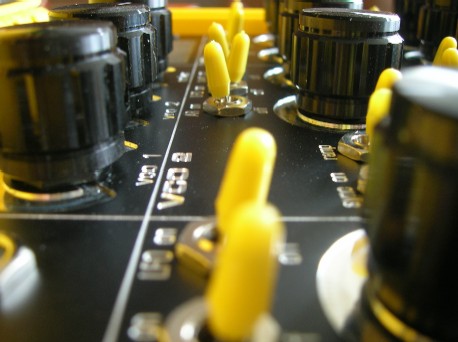
Synth DIY by fonik

close up
flickr photo be fonik2000

My electronics workstation in the garage has been closed for the winter due to extreme cold.  Not that I’ve had the time, anyways.  However, the temperature is on the rise, and I’m looking forward to getting back out there.  The big goal I’ve set for myself is to make some of my very own eurorack modular synth units.

And perhaps by cosmic coincidence, a modular synth enthusiast, who goes by the name of fonik, commented on one of my flickr photos a couple of days ago.  This led me to his photos, which led me to www.modular.fonik.de.  On his site, he shares in detail his custom modules and schematics.  Having a DIY guide to follow is exactly what I need.

“Rather a musician than an electronics engineer I was always looking for new sounds. This finally(?) let me to modular synth. Once I purchased some Dopefer modules for a modular guitar effect the plan rose to build my own modular synth… this was about 2 years ago and I never held an soldering iron in my hands before.”  – fonik

This is the position I’m in today.  The fact that he has been able to accomplish so much with in such a short period of time gives me hope that I, too, will be able to succeed in my modular synth building endeavors.