This video is crazy awesome!
Video by Computadora Feliz. Link via c64music!

This video is crazy awesome!
Video by Computadora Feliz. Link via c64music!

I want to share with you a promising new site called Csound for Newbies.
“The purpose of this site is to help the feckless, the despondent, the hopeless and the overwhelmed musician, programmer, and/or composer who wants to learn about the Csound audio and music software system.”
I have no clue as to who runs this site. Though it appears we share the common goal of helping those who wish to learn more about the language. Csound is cursed with an initially steep learning curve, and it’s great to see a blog dedicated to addressing this issue.

“The Acoustic, the Digital and the Body: A Survey on Musical Instruments”
“In the autumn of 2006 we conducted a phenomenological, qualitative survey on people’s relationship with their acoustic and digitial instruments. This is part of an ongoing research.”
The survey is still open if you wish to participate.
via HectorC on the Csound Mailing list.
Featuring guest appearances by Trent Reznor, Cat Power, and more, El-P’s follow up to his critically acclaimed Fantastic Damage will knock you out.
via worship the glitch.

“Poor Little Robot” is a piece of music orchestrated for Banjo and Csound Theremin. And I absolutely love it!!
Composer Joseph Sanger wrote the following description to the Csound mailing list:
I have just posted an mp3 on my myspace site which uses Csound in a small way and wanted to share it. It’s not particularly highbrow but you might find it amusing, it’s a rather poignant duet for Banjo and Theremin. I modelled the theremin in Csound (not complicated) and played it with a MIDI keyboard, recording it live into Ardour via Jack, so no Csound score exists.
“Hi. I don’t vlog, but I might someday.”This is thumbuki.com’s premiere episode, where Jake visits with his buddies, Eric and Justin, at blip.tv headquarters. And then they all go play video games.
Filmed April 4th, 2007.

C64Music! is a weekly journal about Commodore64 related geek music projects, featuring DIY, schematics, releases, C64 bands, retro software reviews, SID based synths… you could call it a Multiple Sidosis…
I think I’m going to pull out my SidStation later. I’m inspired.
A good friend of mine recently sent me a link to “Music: a Mathematical Offering” by Dave Benson. I’ve only briefly skimmed the text. However, I can already assure you this free online book is full of useful information. It does veer into the technical, as it is packed with equations that may seem a bit alien to some. Don’t let this dissuade you, as there is plenty of knowledge for people of all backgrounds.
The PDF is 524 pages long, making printing a not-so-viable option. For those who wish to read a hard copy, you can purchase the book from Amazon.
Here is a list of chapters in the online version:
1. Waves and harmonics
2. Fourier theory
3. A mathematician’s guide to the orchestra
4. Consonance and dissonance
5. Scales and temperaments: the fivefold way
6. More scales and temperaments
7. Digital music
8. Synthesis
9. Symmetry in music
I would also like to point out that my synthesizer of choice, Csound, is covered.

Just last week, a friend of mine was telling me that Csound is included in the One Laptop Per Child program (OLPC.)
Last night, I coincidentally stumbled across the development blog for TamTam, “a suite of three applications / activities developed for the $100 laptop.” [source] The program is implemented using Python and PyGTK, and utilizes Csound as its synthesis engine. The TamTam GUI appears to be very user-friendly, and reminds me of a simplified version of Max/MSP combined with a midi sequencer.
The OLCP is, among other things, a musical instrument. The fact that this musical instrument is going to make its way into the hands of children spanning dozens of cultures fascinates me to no end.
As a side note, I can’t help but think of the NAVI computer in Serial Experiments Lain. I look forward to the day OLPC laptops become commercially available, so that I may get my hands on one.
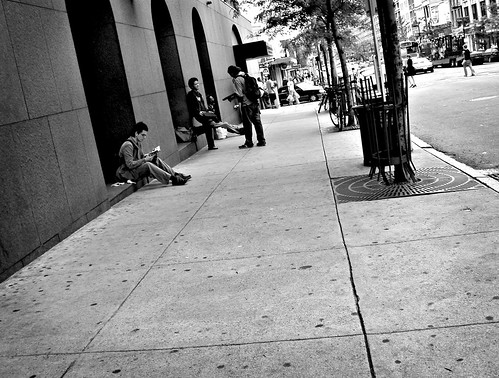
Flickr Photo by Me.
While looking for groups to join at flickr, I was surprised to learn one did not already exist for the Berklee College of Music. So I created one. It will hopefully become a great place for us alumni to share our pictures of life at Berklee.


