>examine interactive fiction

Yesterday, I blogged about my first foray into the world of Interactive Fiction. While searching the web last night, two things in particular grabbed my attention.

The first is a blog post at Dorophone titled “On Inform 7, Natural Language Programming and the Principle of Least Surprise.” The article is clearly written from the viewpoint of a coder. The author does an excellent job of examining the “natural” qualities of Inform 7’s syntax, discusses many of the positives and negatives of programming in such an environment, and compares it to other languages such Inform 6 and python.

The other site is Emily Short’s Interactive Fiction. Emily Short writes both interactive fiction and about interactive fiction. After briefly browsing her articles, which I plan to revisit in the near future, I was left with the impression she has developed a mastery of the medium. The information found here is invaluable to anyone interested in interactive fiction, including novices, veterens, and everything in between. I discovered this site thanks to @christophernies, who recommended Galatea, an IF written by Emily Short.

Writing Interactive Fiction with Inform 7

I’m learning Inform 7, a programming language designed to create interactive works of fiction for the same Z-Machine used for many text classics such and Zork and Planetfall. My inspiration comes from Adam Parrish‘s >frotzophone, “an interface for making music with interactive fiction”.

So far, I’ve put in about three hours. Within this time frame, I’ve already been successful at creating some very rudimentary, yet interactive environments. The syntax of Inform is by far the highest level language I’ve personally ever encountered; Coding requires the use of real english language. That fascinates me, and at the same time, hard for me to wrap my brain around.

Below is the in-game action of a demo I wrote to learn the language, followed by the actual code used to create the work.

The Hack-o-torium
An Interactive Fiction by Jacob Joaquin
Release 1 / Serial number 080815 / Inform 7 build 5T18 (I6/v6.31 lib 6/12N) SD

Hack-o-torium
This room looks like an astromech spewed its guts all over place, as each nook and cranny is filled with odd electrical devices, wires, resistors, etc. You hear the busy street traffic below.

A simple but well crafted wooden staircase is here.

A large wooden table resides near the giant windows.

On The large wooden table is a bottle (closed) (in which is a clear brown liquid).

>climb stairs
Continue reading

Csound Journal Issue 9

Csound Journal Cover Art

James Hearon and Steven Yi have recently released Issue 9 of The Csound Journal. This just might be the strongest issue yet.

NYC Resistor Art Show Round-Up

NYCResistor Art of the Game Party
Photo by Bre Pettis

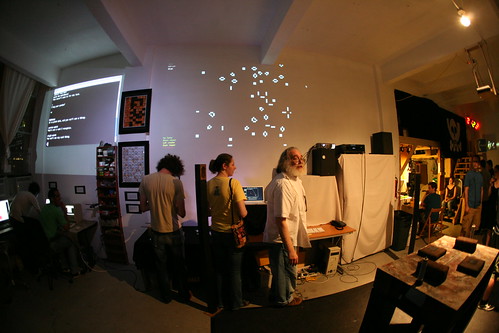
Two saturdays ago, NYC Resistor presented Art of the Game, an art show / party showcasing over a dozen works of game-inspired art. Though I’m a bit biased, being one of the featured artists, I have to say the event was a huge success. Every piece on display was personally very inspiring. Here are two flickr photo sets from the event:

Art of the Game Party at NYCResistor by bre pettis
Art of the Game @ NYCR by thumbuki

Here is a list of all the artists and pieces shown at Art of the Game:

Mortal Kombat Dizzy Dance Party
Aaron Meyers

SL:PONG
William Ward and Andy Fundinger
Second Life and Arduino

>frotzophone
Adam Parrish
Processing and hacked Frotz

Cobosoda Arcade
Justin Day and Jacob Joaquin
Java, Processing, Slipmat, and Csound

Game, Game, Game and Again Game
Jason Nelson
Online Game

Alarmingly These are Not Lovesick Zombies
Jason Nelson
Online Game

Game Over
Zach Vitale
C-print

Yolks on You
Zach Vitale
C-print

Mano a Mano
Andrew Y. Ames
Speaker boxes, walnut, steel, leather and custom electronics

MarioMarioMarioMarioMarioMario
Justin Day
C and hacked Gameboy

8-bit Music
Eric Skiff
Nanoloop and vintage Gameboy

This Game is Too Complicated for You to Play
Dave Clausen
RGB LEDs, Atmega 168 and Toner Transfer DIY circuit board

Nihilist Foosball
Adam Mayer

Conway’s Game of Life
Jared Klett
Java

Attention Hog
Chris Basmajian
Flash Action Script

If you were an artist at this show and noticed that I missed something import, email me at jacobjoaquin [AT] gmail.com and I’ll make the change.

Coding in Processing Explained in Five Minutes

I’m relatively new to Processing, having spent only one solid month with the language. Within this time frame, I was able to write a complete GUI interface for Cobosoda styled after 80s vector arcade games. I don’t attribute this to my “mad programming skillz,” because I’m mediocre at best. Instead, I place the blame squarely where it belongs; On Processing.

Now that I’m a fan of the language, it is my duty to promote it on my blog, and try to get others to hop on the Processing bandwagon. For those completely new to Processing, this slideshare by Peter Kirn will quickly get you up to speed.

Processing: It’s the new Logo, except très cool and super powerful.

Art of the Game @ NYCResistor

DaVinci's Laster Tag Era

I’ve recently collaborated with Justin Day on a project called “Cobosoda Arcade”, a physics simulation video game in which players design, race and evolve 2-D stick-figure robot automatons. And we are presenting the piece this saturday night at the Art of the Game show / party at NYCResistor.

Cobosoda Arcade

When: July 26th 2008. 9PM
Where: NYCResistor (397 Bridge Street, 5th floor)
What: Party and Art Show!
How Much: $20 cover. (open bar)
Why: Fundraiser to keep us going!

Visit nycresistor.com for details. Hope to see you there!