
Part of Get BentCircuit Bending: The Spin Brother
time lapse video of real life circuit bending, edited to sounds made by the real circuit bent toy.
Tag Archives: instruments
My First Victim

The scene of the crime
I bent my first circuit this Saturday, with limited success.
The victim was a cheap-o $5 keyboard from walmart. Opening it up was as easy as removing the screws. What I found inside was very little in terms of electronic components. There were two long narrow boards that acted as the controllers for the buttons and keys. And then there was this tiny little square where all the “stuff” happened.
Connecting the limited set of dots I had to work with, I found three distinct circuit bending functions: The sound stopped, a popping sound came out of the speaker (which is bad), and the rate at which the samples played back increased by ten-fold. So I soldered a toggle to the only pair of interesting dots on the board. The end. Being useless, I’ll go back and reclaim my toggle.
What did I learn? Uninteresting toys can make for uninteresting bent instruments. Newer toys are probably much more efficient in design, thus having fewer circuits to bend. Don’t touch the hot part of a soldering iron.
Part of Get Bent
So easy, even children can do it
Hands on with a Soldering Iron

My first solder
Earlier this week, I stopped by my local Radio Shack and picked up a soldering iron, wire, and a stripper. Yesterday, I finally had a chance to use it when I pulled out an old PC modem card (for practice) and went to town.
I managed to solder six wire ends to random spots on the board. The reason I didn’t do more is because the room I was in clearly wasn’t ventilated properly (got a little dizzy.) The first thing I learned was that the gauge of wire I’m using is a little too thick, though still workable. Second thing was that it was easier to put some solder on the tip of the wire first, then place the tip on the spot I wanted it connected to, and then heat the wire, causing the solder to precisely melt into place. In the end, all my wires were attached well enough that I could lift the board. And none of my solder leaked into an adjacent point of electronic interest.
This weekend, I plan on setting up a space in the garage, so that I don’t have to kill as many brain cells next time. And so that I can finally take apart a toy instrument and play connect-the-dots.
Part of Get Bent.
Know Your Roots: Reed Ghazala
I would be in a state of sin if I didn’t mention early-on the internationally recognized “father of circuit-bending,” Reed Ghazala.
Ghazala’s website, www.anti-theory.com, is a haven for the odd and strange in the electronic arts. Besides Circuit-Bending, Ghazala has also involved himself with the visual arts. My favorite is his work with polaroids. Be sure to read up on the man himself.
If you are interested in giving circuit-bending a try, then the first thing you should read is Ghazala’s 19 page primer. This is more than enough (but not too much) information to get anyone started. If you want to dive even further into his world, Ghazala has written a book, Circuit-Bending: Build Your Own Alien Instruments. I’ve already ordered my copy.
Part of Get Bent
Thumbuki Presents: Get Bent
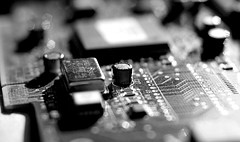
From what I’ve read, bending capacitors of this magnitude might blow your fingers off. Or at minimum, learn you real quick never do that again.
Love noise? Love toys? Perhaps circuit bending is for you./
To celebrate Thumbuki’s soft launch, we’re kicking off our our first original series: Get Bent
And by original series, I mean I’m personally going to be doing research on “circuit bending” over the next few weeks, and sharing my findings with you. I will post here the top relevant links, video, tutorials, historical accounts, etc, as I find them.
What is circuit bending? According to wikipedia:
“Circuit bending is the creative short-circuiting of low voltage, battery-powered electronic audio devices such as guitar effects, children’s toys and small synthesizers to create new musical instruments and sound generators. “
Also check out this video example of circuit bending by James Anderson.
As for me, I have zero hands-on experience with electronics. Though I do have some familiarity with everything from modular synthesizers to Csound. So I plan on getting very used to the idea of holding a soldering iron in the near future. I will be reporting back to you all of my successes and all of my failures as I turn children toys into little electronic frankensteins. For art’s sake.