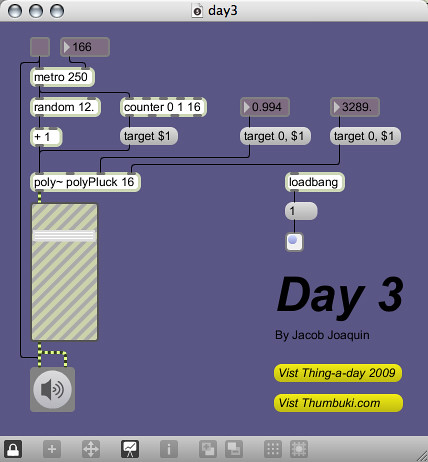
Yesterday, I built a simple Karplus-Strong synth. I created a poly~ version of that synth and am using it as a component in today’s music box instrument.
Download – day3.mxf.zip (requires Max 5)
Listen – Day3.mp3
Reposted from Thing-a-day 2009

Yesterday, I built a simple Karplus-Strong synth. I created a poly~ version of that synth and am using it as a component in today’s music box instrument.
Download – day3.mxf.zip (requires Max 5)
Listen – Day3.mp3
Reposted from Thing-a-day 2009
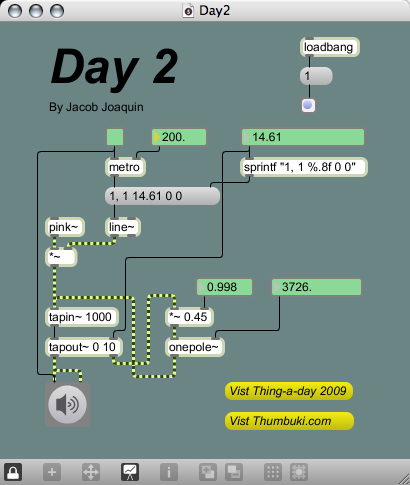
A simple Karplus-Strong synth implemented with Max 5.
Download Max patch.
Download mp3.
Reposted from Thing-a-day 2009
So I’ve decided to participate in Thing-a-day 2009. Which means that starting yesterday, I will create ten things over ten days, and share it with the world. Here’s a repost from my entry from yesterday:
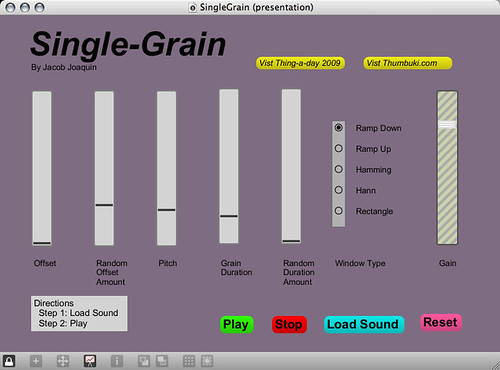
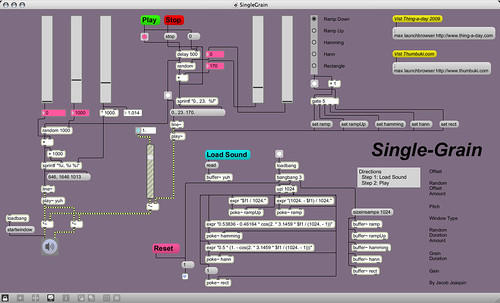
Single-Grain is a simple granular synthesizer/audio processor built with Max 5.
You can download the original Max 5 Single-Grain patches here. If you don’t own Max 5, but own a Mac, you can download the stand-alone application here. Mileage may vary.

Congratulations to James Hearon, Steven Yi and contributing authors for the 10th issue of The Csound Journal.

Is it possible to compose beautiful Csound code? Let’s find out. I hereby declare The Csound Format Challenge.
Though it may sound like a contest, I really consider this more as a friendly medium to explore and share various ways to write Csound code. In order to participate, all you have to do is to take the following unformatted CSD file, change it to your liking, and share it with the world:
Here’s my attempt:
There’s no right way or wrong way. No winner will be declared. Feel free to submit as many entries as you would like. Cheating is allowed, so if you see something you like from someone else’s work, incorporate it into you own examples.
And have fun!
I’ve been itching to build a workshop/hacker space for some time. I finally have the tools, the materials and space in my garage. First order of business, build a workbench. I could easily purchase a workbench, but part of the fun of having a workshop is being able to build things with my own two hands. (it’s also cheaper)
I studied various plans on the web, including a design by Bre Pettis. I’m using his design as as starting point for mine.
I’m making a few changes, to better match my needs and the space. For example, since I’m working in a garage as opposed to a NYC apartment, I have the luxury of extending the depth by 6″, or more. Tinkering with the design is proving to be just as much fun as any thing. It’s also giving me the opportunity to learn SketchUp, which is proving to be a valuable asset to my toolkit.
Here’s what the design looks like in its current form:


Once it’s done, I’m firing up my soldering iron busting out the Forrest Mims books on electronics.

Analog drum kit. Created with a Eurorack modular synthesizer. Includes eight loops and nine single-shot samples.
Download Analog Kit Lite at ccmixter. Licensed under Creative Commons.
Disclaimer: I’m affiliated with Fugwhump.
Curious minds @ NYC Resistor experiment with audio synthesis from a simple bike wheel alternator
Via Make.
LOL funny. IMHO.