
Finally, after months of not having the time to fix this site, I made the time, and now it’s all good. The problem? I had accidentally erased a sort of important file. Well, technically, the buggy-ass FTP client I was using months ago was the culprit. Now I’m using cyberduck and expect no further problems. Expect normal operations to continue from this point forward.
Yes, I know this site is Broken.
I just haven’t had time to fix it, though I have made many daring attempts with zero success. Thought you should know why I haven’t updated in awhile. Someday, I’ll get this place back up, even if it means starting it from scratch.
Happy “Halo 3″ Day!!

JumpBean Synth
A Sketchbook project – exploring a physics based instrument.
JumpBean Synth. Posted to Blip.tv by AngryBeth
Share Your Library with “Shelfari”

Last night, I discovered Shelfari, a social networking site centered around books.
Shelfari introduces readers to our global community of book lovers and encourages them to share their literary inclinations and passions with peers, friends, and total strangers (for now). Shelfari was the first social media site focused on books, and will continue to innovate as it brings together the world’s readers.
So far, I’ve put 95 books on my shelf for the world to see. Though I’ll have to start digging through boxes soon if I want to continue adding more. I’m being very selective of which books I’m making public. Not that I’m ashamed of anything, but I want to make sure that I display titles that are worthwhile, leaving out any and all potential filler, which I’m sad to say does take up too much of my physical shelves here at home. Besides, is anyone really interested in my copy of “Chicken Soup for the Soul.” (I don’t actually own that.)
Thanks to cornpone for the link. Visit his two sites, lemon pepper hot wing and trypanblue.
The MIDI File Format

4d 54 68 64 00 00 00 06 00 00 00 01 00 60 4d 54 72 6b 00 00 00 08 00 9f 40 7f 60 8f 40 7f
Today, I’m learning how to generate MIDI files with Perl. So far, this has been a fairly straight forward process. This is most likely due to the fact that MIDI hasn’t really changed since 1983.
Here is the guide I’m following.
Steampunk Lappy
Via Fuzzytopia.
Endorphin – quad SID synth
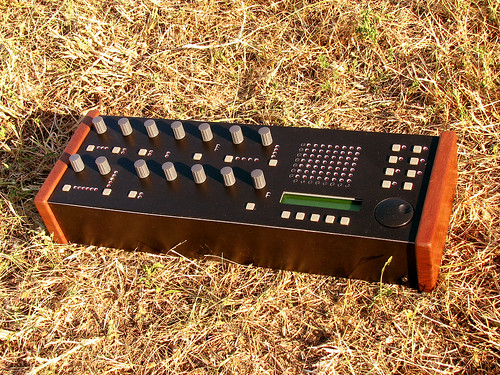
This custom SID synthesizer sounds absolutely awesome. Listen to it here.
ShellVerb: Csound Command-Line Effects Processor

About a month ago, peiman posted a question to the Csound Mailing list about the possiblity “to batch process several audio-files with the same csound code.” Prior to this, I had never considered using Csound in this manner.
After some discussion on the list about how to do this, I presented a simple solution using the command-line. This bash call was then refined by sand-6.
I continued to work on this, as there were still a few unresolved issues. For example, designing Csound instruments that would process mono or stereo files automatically, and being able to set parameters from the command-line. I wrote ShellVerb v0.1 to demonstrate a way to build these abilities into command-line instruments. Though I wasn’t completely happy with my approach.
I revisted ShellVerb yesterday, and came up with ShellVerb v0.2. This version, in theory, works identically to v0.1 as far as the user is concerned. However, I made some changes internally that I hope are a bit more clear to those wishing to analyze the file so they can write their own Csound based command-line audio tools.
It turns out that not only can Csound be used as a batch processor, but it also makes for a damn fine one. Csound is chock full of filters, envelopes, digital siginal processors, spectral processors, etc. From these synthesizer/dsp modules, one can design very complex effects units that would be impractical to implement in most other products out in the wild. Since the original post at the mailing list, I’ve heavily incorporated Csound command-line processors into some of the projects I’m currently working on, with stellar results.
Download:
Fast Tracker II with DOSBox

Sometime in the early 90’s, I was introduced to the DOS app ModEdit, a sample based compositional environment, known as a tracker. I never produced a finished piece of music, though I did screw around with it quite a bit. When I discovered Future Crew‘s Scream Tracker 3, I basically went through the same process, with the exception that I actually composed and released my first mod “Lore.” Terrible, it was.
Then came along Triton’s Fast Tracker II. This was light years ahead of trackers that came before it. It had an exceptional user interface, and many highly useful features not present in other trackers. It was very crude, yet an effective 8-bit era recording studio. And I have a lot of fond memories surrounding FT2.
DOS as an operating system is dead. Though it has been resurrected in the form of DOSBox, a cross-platform emulation environment that runs legacy DOS apps. Including Fast Tracker II.
Though I doubt I will ever again use FT2 as one of my primary compositional tools, I’m grateful that I’m able to revisit dozens of unfinished works, as it’s been fun recycling old mod loops with Ableton’s Live.
My only regret in life is that I never sent Triton my $20 dollars.
Get: