On the Up

The Csound community has been making strides to improve the user-experience, and this effort is really beginning to shine through.

Csound now ships with QuteCsound, a new integrated frontend that comes loaded with extras.  The Csound @ Sourceforge page has been given a facelift, in terms of both looks and content.  The developers are taking much greater care to make sure installers work with as few as problems as possible.  This is only the beginning.

If you have tried Csound in the past, but had problems getting up and running, now is a good time to give it another try. If you do run into problems, don’t keep these issues to yourself.  Report them here or the mailing list, and these problems will be taken care of.

Thanks to all the hard work of the developers and others in the community, as it seems that Csound has a promising future.

Csound Music mp3 Pack

Dr. Boulanger has put up a wondeful collection of Csound mp3s at Csounds.com.

Download 4csoundCompositions.zip (99.1 MB)

The pack comes with 20 songs, with everything from ambient to minimal to cheesy techno (that would be my piece) to synth-generated halloween sound fx.  All of the original source code is included in case you are curious to see what these compositions look like in their original state.

The Csound Blog is moving to Noisepages

Csound Dseq Drum Machine

In 2006, I started The Csound Blog, a site dedicated to all the quirky goodness of Csound. I haven’t touched it in years, but have been pondering starting it back up for quite some time.  I’ve decided to move forward with it, and I’m moving it over to Noisepages in the process.

Starting today, I will begin migrating the original posts to its new home here.  Then after that, the real fun begins.

Micro Sizzle

Micro Sizzle

I’ve been meaning to experiment with additive and granular synth techniques for sometime. When I heard about Tobiah’s Sine Composition Challenge, I figured I could use this as a fairly good excuse to move forward.

The point of the challenge is to compose music using a simple Csound instrument that only generates sine wave. I decided to focus on creating a processor that converts audio into short bursts of sine waves. Something that sounds less pretty and more nasty. And this how I did it:

I took a 1-minute stereo audio file created with Ableton Live. This file was then analyzed with Csound using the pvsbin opcode. See getSizzleData.csd. Using the printks opcodes, the analyzer writes out information about the audio file to the Csound console, data such as bin number, k-block index, amplitude, frequency, and which stereo channel. The data was captured to the sizzleData.txt using this command-line in Terminal window in OS X: csound -g getSizzleData.csd 2> sizzleData.txt.

The next step was to process the numbers and transform it into a new Csound score. This was achieved using the Perl script createSizzleScore.pl. This created the Csound score MicroSizzle.sco. This file contains over 160,000 i-events, and is a little over 13 MBs big.

After the score was generated, it was simple a matter of rendering an audio file in Csound using Tobiah’s sine orchestra. The output reminds me of a real lo-fi internet audio stream circa 1999. Nasty achieved. And that’s how MicroSizzle was made.

This whole process is just a starting point, a rough draft if you will. My hope is that once I spend some time tweaking parameters, I’ll be able to make serious improvements to the overall output of this additive resynthesizer.

Download: MicroSizzle.mp3, MicroSizzle.zip

Thing-a-day 26: Thingy

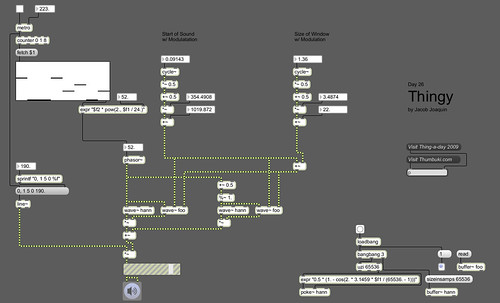
Day 26: Thingy

This does something. And what does it do? To be honest, the name of this synth technique escapes me at the moment. More or less, the engine creates an oscillator by cycling through a windowed segment of a buffer, with the window having the ability to move positions within this buffer.

The audio source used in the example is the same music box recording that was used in Day 4.

Listen – Day26.mp3

Download – day26.maxpat.zip (requires Max 5)

For Thing-a-day 2009.