Fragments of a Bohlen-Pierce Composition (Pt 9)

The program notes and biographies for the for the Bohlen-Pierce Symposium are now posted; Here’s mine.

I’m currently blocking out the structure of the piece, and would like to take a moment to discuss what’s bouncing around the confines of my skull. From the program notes:

“This direction emulates the way in which a hacker approaches the challenge of dissecting a piece of software or electronic device.”

Second:

“There’s always a rhythm to the space between things. Pause, hold the thought, check the moment. Repeat. Wait. There it goes again. Another thought, another pause in the stream of conscious in another abstraction–the reader, the listener. Speak these words out loud, and the same logic applies–there’s always a rhythm to the space between things.” – Paul D. Miller (aka DJ Spooky, That Subliminal Kid), Sound Unbound

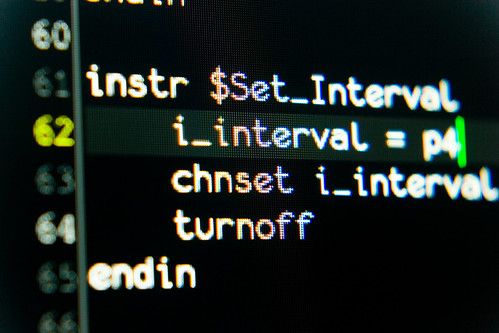
I believe there is a rhythm to computer code. The way it reads, the way the computer reads it, the way logical expressions are grouped, how it functions as a whole, how data is pumped in one side, translated, and then poured out the other side, etc.

Since I’ve adopted a hacker-like approach to the Bohlen-Pierce scale, I felt compelled to translate elements of coding into aspects of the composition. Each line of code is a statement. A grouping of related code is a statement. Each feeds off and into other statements. And there is a rhythm to be found in between all of them.

The title Fragments also implies multiple things. I have a collection of various musical statements and processes. I’m trying to figure out how to hack these individual ideas into single functioning work. I want the listener to be able to hear each fragment individually, while hearing them together as a functioning unit. This idea is a lot like code. Any single function or subroutine can be analyzed individually, ignorant of everything else. Though this same subroutine is still part of a larger functioning unit, the program. Am I making any sense?

What this all boils down to is that I want the piece to be perceived as discrete, yet having a natural flowing rhythm to it. This is what I’m trying to achieve. I’m now trying to establish that rhythm. I’m about half way through. And when I’m done, that’s when real fun starts.

Download: fragments_9.csd
Fragments of a Bohlen-Pierce Composition (Pt 8)

Since discovering my opening statement, I’ve been itching to place it within a musical context. I developed a rough outline of what the first minute of the piece may sound like, ending with a possible transition into the second part of the composition.

Download: fragments_8.csd

There is a lot of space in there, which will give me a lot of head room when I go back to this section to flesh it out and polish it up. Especially with spatial elements, like panning, reverbs and echos.

I need to bring up something else. Turns out that the chn opcodes are broken on some platforms, which is preventing people from not being able to render these csd files. Unfortunately, I don’t have time to go back and convert my effects routing to zak or similar system. So in the mean time, if you aren’t on OS X, you won’t be able render the csds. However, I’m told that the bug has been fixed in CVS, so these files should work in the next release of Csound. Sorry for the inconvenience.

Fragments of a Bohlen-Pierce Composition (Pt 6)

What this piece needs is a simple motif. Simple, but capable of making a strong impression from the get-go. Sounds like a no-brainer, right? After all, the concept of “the hook” is straight out of music writing 101.

Since most people have little to no experience with Bohlen-Pierce, myself included, the music can sound alien. A strong recurring motif that is established in the first few seconds of the piece may give the audience a sense of familiarity by the end, as opposed to a series of seemingly random frequencies.

Over the last few days, I’ve been spending my time in front of my MIDI keyboard, trying various phrases and chords, and listening to the results while letting the tonality of Bohlen-Pierce sink in. I had been flirting with the just intonation. I’m now of the mind to go with equal temperament. With just intonation, I had a tendency of writing melodies that were akin to badly tuned 12-tone music.

Here is the Bohlen-Pierce tuned MIDI synth I’ve been using for the last couple of days:

Download: fragments_6.csd

I’ve split the keyboard into two voices, where c-3 and c-5 are two octaves apart. There is a split somewhere in the middle.

Fragments of a Bohlen-Pierce Composition (Pt 5)

If you took a bunch of random magazine clippings, created a disorderly stack, topped it with a rotten banana peel, and stapled it all slightly off center, you might get something that sounds like this:

Download: fragments_5.csd

This is just a sound test to see how all of these fragments so far fit together. As you can hear, I have my work cut out for me. Starting right now, I need to focus on motives, melodies, chord progressions, gestures, smarter note generators, etc. You know, the music.

This means putting off the granular synthesizer instrument. Time is of essence, and if I’m going to make a trade off, I’d rather put emphasis on the harmony of Bohlen-Pierce rather than designing another synth. I’m not saying the granular instrument won’t happen, because I’m actually quite confident I’ll have to the time to do it, and do it right. I just don’t want to find myself in a position where I’ve poured hours and hours into all these instruments, and not end up with a decent piece for the concert. It’s very easy to get caught up in all the technical stuff when composing a piece of computer music. Something I’m personally very guilty of.

Fragments of a Bohlen-Pierce Composition (Pt 4)

Since Friday, I’ve had almost nil in terms of time to work on fragments. The little time I did have, I put together an additive synthesizer prototype, which I call Tadd for the time being; short for Table Additive Synthesizer. Perhaps I should be calling it tads? It’s very rough, glitchy and a bit poppy, but I love it.

Download: fragments_4.csd

I’m not going to go into the details on how it works here. It’s still in early development, and I plan on only using it in a rough state for fragments. It’s a time constraint thing. Beyond this Bohlen-Pierce piece, I have some big ideas for Tadd, and will most likely write an article about it for the Csound Journal. In the mean time, if anyone has an questions about it, I’d be happy to answer.

Where am I with the piece? I now have a pretty good idea what my final instrumentation will be like. Effects will play a major role in this. I’m considering writing a stutter delay buffer, and possibly a trippy space dub echo machine. There will be heavy use of note generating algorithms present. Timbre wise, it could use one more instrument that contrasts the FM and additive sounds. I’m thinking granular.

There is the question of whether or not to do this in 4-channel quadraphonic surround. If there is time, I’ll give it a try. Though technically speaking, I’m not set up for it here. I’m not ruling it out, yet.

As for a metaphor for what the piece is about… That’s just now coming to me, but it’ll take me a few more days before it truly begins to manifest. The one thing I’m hoping to avoid is to use the Bohlen-Pierce scale as a gimmick rather than a primary element of the piece.

Note to self: listen to more Autechre this week.

Fragments of a Bohlen-Pierce Composition (Pt 3)

Whenever I start a piece, especially one based in old school computer music, I usually find myself working in a compositional clean room. What I mean by this is I usually have to spend many hours writing synthesis code that produces very sterile sounding textures and blips that lacks both depth and soul before moving on. Sometimes I never actually make it beyond this point. To be completely honest, I kinda dig the sound of it. However, I made promise to myself right before the new year that I’m going to force myself to get out of my comfort zone. This means taking off the clean suite, getting outside and playing in the mud. Where “mud” is obviously alluding to the organic. (note: there is some dripping sarcasm in the last line) Though I’m making a joke, mostly intended for myself, there is some truth to this.

As for Fragments, though I’m still in that clean room, I’m starting to make the transition. Today’s example is that first step, and very small one at that. I’m spending more time on the overall sound of the piece, space and structure. As opposed to just creating a process and letting it run for x amount of minutes.

One thing of particular interest is that I’m applying Bohlen-Pierce ratios and proportions to various elements of the piece. Such as note duration, envelope, next start times, FM modulation indexes and ratios, etc. Though I can’t claim this idea as mine, as it came from friend and mentor Dr. Richard Boulanger who had suggested it to me in an email.

Fragments 3: fragments_3.csd

Fragments of a Bohlen-Pierce Composition (Pt 2)

Though my intention is not to produce a phasing piece for the Bohlen-Pierce Symposium, I am using this technique, made famous by composer Steven Reich, as a vessel to get some of the harmonies of the tuning system into my head. Already, I feel there are some potential melodies, chords and even interesting rhythms that are jumping out at me that I could potentially use in a final piece. Though there is still a long, long road in front of me.

Bohlen-Pierce Etude for Three Phasing FM Voices
bpe4tpfmv.csd

Fragments of a Bohlen-Pierce Composition (Pt 1)

I’ve recently been invited to compose a piece for the first symposium on the Bohlen-Pierce scale, which takes place in Boston a month from now. This will be very challenging personally since I’ve never composed using this tuning. I’ve decided, after a little encouragement, to blog about my progress.

I’m doing the piece with Csound, which should come as no surprise. Minus a few scribbled notes in my journal, I have no idea what I’m going to do or where I expect this piece will sound like a month from today. Since time is of essence, I’ve started putting some code into a text file, and have come up with this csd: bp_day_1.csd.

At this point, it produces a series of random just intonation Bohlen-Pierce notes, which are  fed to a monophonic FM portamento synth, and processed with a delay and a reverb unit. A humble beginning for sure.