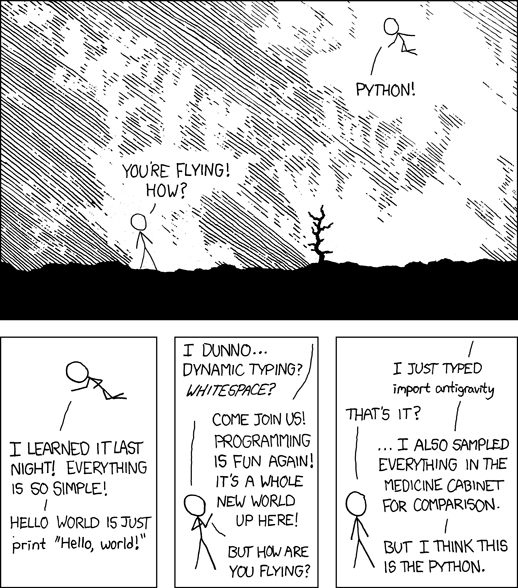
List Comprehension Grain Generator

This is a granular synthesizer:

@[random() * 8 for i in range(1000)] foo()

This generates 1000 events over the span of 8 beats, using list comprehension.

The function foo() is intentionally left blank. It may produce random single-cycle waveforms, bits of a sample, or glowing TRON-like particles for your live performance visuals. Whatever.

Custom Sequence List Generators

Python’s built-in range() list generator is full of possibilities when used in conjunction with Slipmat’s @ scheduler. And that’s just one generator out of, dare I say, a million possibilities.

Imagine being able to conveniently import generators from a massive user library of modules. This will be a reality for Slipmat for two reasons:

I built a list generator called range_plus(), which takes Python’s range() function a few steps farther. range() is limited to integers; range_plus() removes this restriction and allows for floats. range() supports a single increment step value; range_plus() additionally allows users to pass a list of increment step values that are chosen at random.

Here’s the working Python defintion for range_plus():

def range_plus(start, stop, random_steps=1):
    '''
    Returns a list of successive incremented values
    chosen randomly from a list.

    Input:
    start -- Starting value
    stop --  End point
    random_steps -- A list of incremental values chosen at random or a
        single numeric value

    Output:
    return -- A numeric list
    '''

    if stop < start:  # Avoid infinite loop from bad input
        return []

    if not isinstance(random_steps, list):
        random_steps = [random_steps]

    L = []

    while start < stop:
        L.append(start)
        start = start + random.choice(random_steps)

    return L

I made sure to write the docstrings, to make life easier for anyone who may import my code later. Here's a Python interpreter session to test out some numbers:

>>> from MyListGenerators import range_plus
>>> range_plus(0, 4, 0.5)
[0, 0.5, 1.0, 1.5, 2.0, 2.5, 3.0, 3.5]
>>> range_plus(0, 4, [0.25, 0.25, 0.5, 0.75])
[0, 0.5, 1.0, 1.5, 1.75, 2.5, 3.0, 3.25, 3.75]

As applied to music, range_plus() would be a perfect fit for randomly generating rhythmic patterns, for things such as hi-hats.

@0  @range_plus(0, 4, [0.25, 0.25, 0.5, 0.75]) hat()
@4  @range_plus(0, 4, [0.25, 0.25, 0.5, 0.75]) hat()
@12 @range_plus(0, 4, [0.25, 0.25, 0.5, 0.75]) hat()
@16 @range_plus(0, 4, [0.25, 0.25, 0.5, 0.75]) hat()

Here's is one scenario for what those patterns would look like in trigger notation:

Bar 1:  x.x. x.xx ..x. xx.x
Bar 2:  xx.. x..x ..x. .xx.
Bar 3:  x..x ..x. xx.x .x..
Bar 4:  x.x. .xxx .xxx x..x

The 'x' is a 16th note trigger, the '.' is a 16th note rest, and spaces are used to distinguish between each quarter note.

Auto-Generating Lists

In yesterday’s blog, Lists as Micro-Sequencers, we discussed writing lists instead of individual events. Today, we’ll generate lists instead of writing list values.

Python comes with the built-in range() function that generates and returns a list of integers, which can be used to schedule events. The following python interpreter session demos range() with three sets of args along with their respective outputs.

>>> range(4)
[0, 1, 2, 3]
>>> range(5, 9)
[5, 6, 7, 8]
>>> range(0, 16, 4)
[0, 4, 8, 12]

The range() function can be a huge saver of time and keystrokes. Especially if you’re composing goa trance:

@range(1024) goa_kick()

“The kicks are done, man.” Just to be absolutely clear, that generates 1024 goa_kick() events, one per beat.

Frogger

This is what happens when frogger doesn’t look both ways before crossing the street / pond:

gi_square ftgen 4, 0, 256, -7, 1, 128, 1, 0, -1, 128, -1

instr 1
    idur = p3
    iamp = p4

	kenv line 0.00230, idur, 0.01978
	a1 oscil iamp, 1 / kenv, gi_square
	out a1
endin
...
i 1 0 0.96493 -0.707

Download: dead_frogger.csd

Lists as Micro-Sequencers

On Friday, I listed nine ways in which python methodologies could be used with the @ scheduler. How would they work in a real-world musical context? Today, I’m showcasing the List as a super convenient micro-sequencer.

When the @ scheduler is given a list of numbers, every value in the list is used to schedule an event; This saves keystrokes and increases legibility. Let’s see this applied to a simple four-beat rock groove with 8th note hats:

@[0, 0.5, 1, 1.5, 2, 2.5, 3, 3.5] hat()
@[1, 3]                           snare()
@[0, 2]                           kick()

That plays hat() eight times, and snare() and kick() twice each. This beats having to type out 12 events.

Alternatively, an identifier can point to a predefined list, thus, a sequence can be reused multiple times. The following stores a complex hi-hat pattern in identifier p, and then plays it four times:

p = [0, 0.5, 1, 1.5, 2, 2.25, 2.5, 2.75, 3, 3.75]

@0  @p hat()
@4  @p hat()
@8  @p hat()
@12 @p hat()

Here’s the shorthand equivalent:

p = [0, 0.5, 1, 1.5, 2, 2.25, 2.5, 2.75, 3, 3.75]

@[0, 4, 8, 12] @p hat()

That’s 40 events in two lines of code, with improved legibility. If this was presented as 40 individual events, it would not be obvious that the same hat pattern is repeated four times.

Banks of Patterns

A list can be utilized as a bank of patterns, a list of lists. In the following example, an empty bank is created, filled with three patterns, and then used in a four measure sequence.

b = []
b.append([0, 0.5, 1, 1.5, 2, 2.5, 3, 3.5])               # x.x. x.x. x.x. x.x.
b.append([0, 0.5, 1, 1.5, 2, 2.25, 2.5, 2.75, 3, 3.75])  # x.x. x.x. xxxx x..x
b.append([0, 0.5, 1, 1.5, 2, 2.5, 2.75, 3, 3.5, 3.75])   # x.x. x.x. x.xx x.xx

@0  @b[0] hat()
@4  @b[1] hat()
@8  @b[0] hat()
@12 @b[2] hat()

Bonus Round — Eight Ways to Notate 8th Note Hats

Some good, some bad, some ugly. All produce the same result.

1. @map(lambda x: x / 2.0, range(0, 8)) hat()
2. @[0, 0.5, 1, 1.5, 2, 2.5, 3, 3.5] hat()
3. @[i / 2.0 for i in range(0, 8)] hat()
4. @[i / 2.0 for i in range(8)] hat()
5. @[0, 2] @[0, 1] @[0, 0.5] hat()
6. @[0, 1, 2, 3] @[0, 0.5] hat()
7. @range(0, 4) @[0, 0.5] hat()
8. @range(4) @[0, 0.5] hat()

Examples 2, 6 and 8 are my personal favorites.

Nine Rules for Scheduling Events

How would Slipmat’s @ scheduler work when applying various Python methodologies?

To celebrate the release of my friend Sarah MacLean’s new book, Nine Rules to Break When Romancing a Rake, here are 9 rules for scheduling events. Each of the following examples produce the exact same result:

1. Individual Events

@0 foo()
@1 foo()
@2 foo()
@3 foo()

2. List

@[0, 1, 2, 3] foo()

3. Identifier

t = [0, 1, 2, 3]
@t foo()

4. List Comprehension

@[i for i in range(0, 4)] foo()

5. Loop

for i in range(0, 4):
    @i foo()

6. Function

def bar():
    @0 foo()
    @1 foo()
    @2 foo()
    @3 foo()

bar()

7. Nested

foo()
1:
    foo()
    1:
        foo()
        1:
            foo()

8. Item Iteration

items = (0, 1, 2, 3)
@[i for i in items] foo()

9. Map

def bar(x): return x
@(map(bar, range(0, 4)) foo()

And a special message for Sarah, “Ninjas.”

Slipmat Prototype & Processing

I experimenting combining the first Slipmat prototype (built with the Csound API) with Processing. Getting the two systems working together was fairly straight forward. Here’s the code that generated the video.

The following method from class Disc does two things when a disc collides with a border: change direction of the disc and trigger a slipmat event:

public void moveDisc() {
    x += xVelocity * SCALE_VELOCITY;
    y += yVelocity * SCALE_VELOCITY;

    if (x <= DISC_RADIUS || x >= width - 1 - DISC_RADIUS) {
        xVelocity *= -1;
        playNote();
    }

    if (y <= DISC_RADIUS || y >= height - 1 - DISC_RADIUS) {
        yVelocity *= -1;
        playNote();
    }
}

The method playNote() also belongs to class Disc, and is where the actual triggering of the Slipmat event occurs. The instances sp1 and sp2 are part of the Slipmat system. The “sp” is short for “sine percussion.”

public void playNote() {
    sp1.playNote(0.0, 0.35 * (1 - x / width), frequency);
    sp2.playNote(0.0, 0.35 * x / width, frequency);
}

Live Coding and Capturing a Perfomance

It’s the latest fad that’s sweeping computer music. And I would love for Slipmat to have this ability in its arsenal of tools. Without having to sacrifice non-realtime rendering for computationally expensive processes, of course.

The following conceptual live coding prototype shows what a simple session would look like if it was modeled on the Python interpreter:

$ slipmat --capture_performance my_session.txt
>>> from LiveCodeSeq import seq
>>> from MyBassLibrary import rad_rezzy
>>> from random import random
>>> p[0] = [int(random() * 12) for i in range(0, 16)]
>>> p[1] = [int(random() * 12) for i in range(0, 16)]
>>> p[0]
[5, 9, 11, 8, 7, 8, 5, 1, 10, 7, 4, 4, 6, 4, 4, 2]
>>> p[1]
[6, 6, 5, 3, 5, 7, 8, 4, 0, 0, 8, 7, 9, 7, 2, 4]
>>> r = rad_rezzy()
>>> s = seq(instr=r, pattern=p[0], base_pch=6.00, resolution=1/16, tempo=133)
>>> s.start()
>>> s.change_pattern(pattern=p[1], on_beat=0)
>>> @60 s.stop(onbeat=0)

I have a gut feeling that there are some changes that should be made. Though as a starting point, this isn’t a terrible one.

Being able to capture a live coding performance would be fantastic. Not sure how workable it would be, but perhaps such a feature would produce a file that could be played back later:

$ cat my_session.txt
@0             global.seed(7319991298)
@4.04977535403 from LiveCodeSeq import seq
@8.43528123231 from MyBassLibrary import rad_rezzy
@10.9562488312 from random import random
@15.6027957075 p[0] = [int(random() * 12) for i in range(0, 16)]
@20.7757632586 p[1] = [int(random() * 12) for i in range(0, 16)]
@26.2462371683 p[0]
@29.3961696828 p[1]
@34.0424988199 r = rad_rezzy()
@40.3211374075 s = seq(instr=r, pattern=p[0], base_pch=6.00, resolution=1/16,
                   tempo=133)
@45.5491938514 s.start()
@47.8991166715 s.change_pattern(pattern=p[1], onbeat=0)
@52.6267958091 @60 s.stop(onbeat=0)

The @ schedules are the times in which return was originally pressed for each event. Looks like I’ll be spending some time with ChucK soon.